

Choosing a card grading company used to be relatively simple: PSA was the obvious choice for many collectors, while Beckett, CGC, and a growing group of alternatives offered different strengths.
In 2026, the decision is more complicated.
PSA has been dealing with an unprecedented submission backlog, temporarily paused several lower-priced service tiers, and is only beginning to reopen capacity. At the same time, CGC, Beckett, and TAG have become increasingly relevant for collectors who want different combinations of price, turnaround time, detailed grading information, or a particular resale market.
So which company should you use?
The answer depends on the card, its potential value, your budget, and whether your priority is maximum resale liquidity, speed, detailed grading data, or simply getting the card safely encapsulated.
The 2026 Grading Situation
The biggest story in card grading this year is PSA’s backlog.
In May 2026, PSA announced that its active backlog was rapidly approaching 10 million cards after submissions increased another 20%. The company responded by temporarily pausing new submissions for Value Bulk, Value, Value Plus, and Value Max beginning June 2.
The backlog subsequently climbed above 12 million before beginning to decline. PSA’s September 8 update reported approximately 9.9 million units remaining and said the company was positioned to evaluate reopening another service tier during September.
That reopening has now started in a limited form. On September 14, PSA introduced a new Standard service priced at $59.99 per card, with an estimated turnaround of 90–100 business days and a $1,000 maximum insured value. The traditional Value tiers remain paused, and Standard submissions are being processed behind existing Value and Bulk orders.
This matters because grading is not just about the posted price anymore. A $20 or $30 submission that sits in a queue for months may not be a better deal than a $40 or $50 service that gets your card back substantially sooner.
And PSA is not the only company experiencing demand pressure. Beckett temporarily paused Base and Standard submissions in August to protect turnaround estimates, with reopening expected September 15. TAG has also been managing its backlog through limited submission drops rather than unrestricted capacity.
That makes 2026 a particularly important year to compare grading companies rather than automatically choosing the biggest name.
PSA
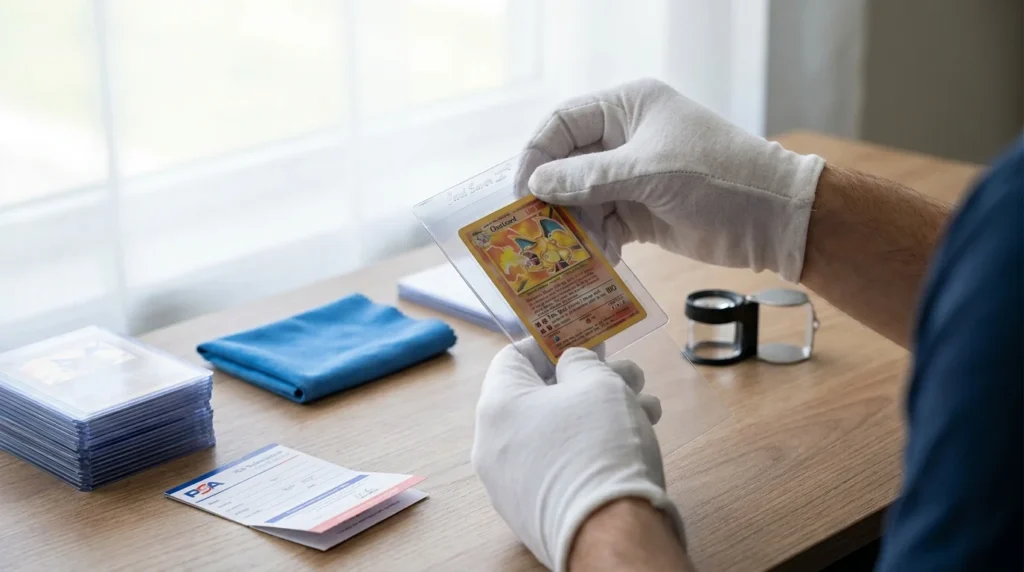
PSA remains the benchmark for many collectors, particularly when resale value and market recognition are the primary concerns.
Its biggest advantage is not necessarily that every PSA grade is inherently “better.” It is that PSA slabs are extremely familiar to buyers, dealers, auction houses, and collectors across the hobby. For many cards, that liquidity can matter when it is time to sell.
The downside in 2026 is availability.
PSA’s current submission portal lists Regular at $79.99 with an estimated 70–80 business-day turnaround, Express at $199 with 20–30 business days, Super Express at $349 with 10–15 business days, and Walk-Through at $599 with 7–10 business days.
The new Standard tier offers a lower entry price at $59.99, but its estimated turnaround is 90–100 business days.
PSA is a strong choice for:
- High-value vintage cards
- Major Pokémon chase cards
- Cards where resale liquidity is important
- Cards likely to be sold through major marketplaces or dealers
- Collectors who specifically want a PSA slab
For an expensive vintage card, the extra market recognition can outweigh the inconvenience of a longer wait.
CGC Cards
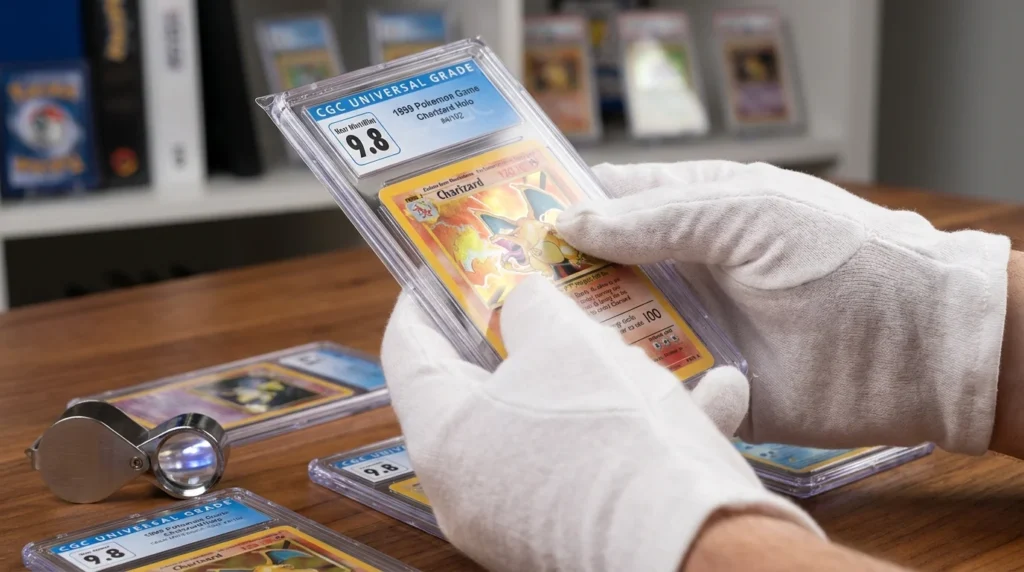
CGC has become one of the most important alternatives to PSA, especially for Pokémon and other TCG collectors.
Its pricing structure is relatively straightforward. Current direct-submission pricing lists Bulk at $15 per card with a 25-card minimum and an estimated 40-working-day turnaround. Economy is $18 with a 20-day estimate, Standard is $55 with 10 days, Express is $100 with 5 days, and WalkThrough is $300 with a 2-day estimate.
That makes CGC particularly interesting for collectors with multiple modern cards who do not necessarily want to wait for PSA capacity to become available.
CGC is also well established in the broader collectibles market, which can be useful if your collection includes more than trading cards.
For a deeper explanation of its process, see our complete guide to CGC card grading.
CGC is a strong choice for:
- Modern Pokémon and other TCG cards
- Larger submissions
- Collectors who want lower-cost grading tiers
- Cards where a shorter estimated turnaround matters
- Collectors already familiar with CGC holders
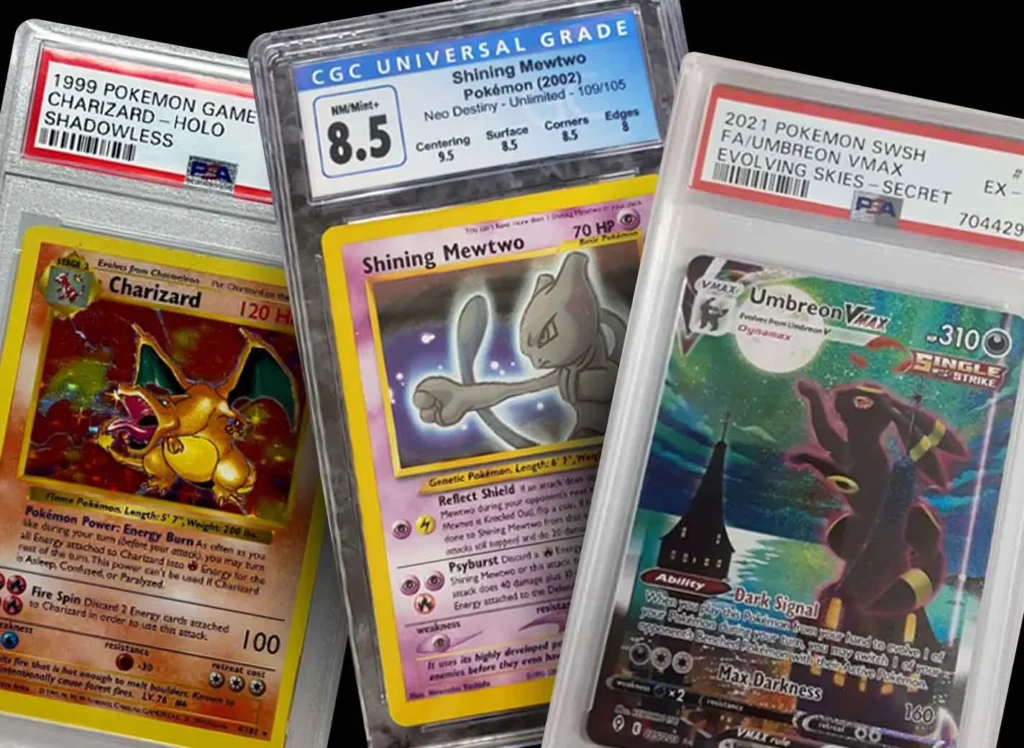
The question of cgc grading vs psa is therefore less about which company is universally superior and more about what you need from the slab.
Beckett
Beckett Grading Services remains particularly interesting for collectors who care about subgrades.
Unlike companies that primarily present one overall numerical grade, Beckett displays separate assessments for centering, corners, edges, and surface. That makes it easier to see why a card received its final grade.
As of the latest 2026 service update, Beckett lists Base at $14.95 per card with a 75+ business-day estimate, Standard at $34.95 with 45 business days, Express at $79.95 with 15 business days, and Priority at $124.95 with 5 business days. However, Base and Standard submissions have been temporarily paused, with Beckett announcing an expected reopening on September 15.
That temporary pause is an important consideration when comparing BGS vs PSA today.
Beckett can also be attractive when a card has exceptional subgrades. A very strong card that earns a high overall grade with excellent centering, corners, edges, and surface can be particularly appealing to collectors who value detailed condition information.
Beckett is a strong choice for:
- High-end modern cards
- Cards with exceptional condition
- Collectors who want subgrades
- Collectors who enjoy detailed condition analysis
- Cards where a top Beckett grade could add collector appeal
TAG
TAG takes a different approach to grading.
Its system is heavily technology-focused, with digital imaging and grading reports designed to give collectors more information about the card rather than simply placing a number on a label.
TAG’s 2026 services include Basic at $22 per card with a 10-card minimum and an estimated 45+ business-day turnaround, Standard at $39 with an estimated 30 business days, Express at $59 with 15 business days, and Priority at $149 with 5 business days.
TAG also provides digital grading information through its DIG reports, along with imaging features that give collectors a more detailed record of the card.
The catch is availability. TAG has been working through its own backlog and moved toward limited submission drops in 2026. Its August update said the backlog had been reduced substantially and that the company was beginning limited submission opportunities.
TAG is a strong choice for:
- Collectors who prefer technology-driven grading
- Modern cards
- Collectors interested in detailed digital reports
- People who want more information about how a grade was reached
- Collectors who are comfortable monitoring submission availability
If automation and detailed digital analysis are important to you, TAG is one of the most interesting alternatives in the current market.
PSA vs CGC vs Beckett vs TAG: 2026 Comparison
| Grader | Entry-Level Option* | Estimated Turnaround* | Main Strength | Best Fit |
|---|---|---|---|---|
| PSA | $59.99 Standard | 90–100 business days | Resale recognition | Valuable vintage and major chase cards |
| CGC | $15 Bulk | 40 working days | Price and TCG accessibility | Modern TCG and larger submissions |
| Beckett | $14.95 Base | 75+ business days | Subgrades | High-grade modern cards |
| TAG | $22 Basic | 45+ business days | Digital analysis | Tech-focused collectors |
*Pricing and turnaround estimates are based on currently published 2026 service information and can change. PSA Standard launched September 14, while Beckett Base and Standard and TAG’s lower tiers have had availability restrictions during the 2026 demand surge.
The table also illustrates why comparing only the sticker price can be misleading.
A $15 submission is not automatically cheaper in practical terms if you need the card back quickly. Likewise, paying more for PSA may make sense for a card where resale recognition is significantly more important than turnaround time.
Which Grader for Which Card?
There is no universal answer to which card grading service is best. Think about the card first, then select the grader.
Expensive vintage cards: PSA
If you have a valuable vintage Pokémon card or another high-demand collectible where future resale matters, PSA remains the safest default for broad market recognition.
The wait can be frustrating, but the slab is familiar to a huge portion of the collecting market.
Modern bulk: CGC
If you have a stack of modern cards and want to control the cost per card, CGC deserves serious consideration.
Its Bulk tier is designed for 25-card submissions and currently costs $15 per card, making it one of the more accessible options for larger submissions.
High-end modern cards: Beckett
For a card that looks exceptionally clean, Beckett can be worth considering because of its subgrade system.
The BGS vs PSA question becomes particularly relevant when you believe a card has the potential to receive exceptionally strong marks across all four condition categories.
Technology-focused collectors: TAG
If you want a grading experience built around digital imaging, detailed reports, and data, TAG offers something different from the traditional grading model.
It is particularly appealing if you care about understanding the condition of the card rather than simply knowing whether it received a 9 or 10.
Sports cards: compare PSA and SGC too
Collectors of sports cards will often encounter SGC in addition to PSA, particularly in vintage and baseball markets.
The SGC vs PSA comparison is therefore worth considering if your collection is sports-focused. For Pokémon and other TCGs, however, the practical shortlist is more likely to be PSA, CGC, Beckett, or TAG.
PSA vs Beckett vs CGC: What Actually Matters?
A common mistake is treating grading as a contest where one company must “win.”
The better question is what happens after grading.
If you plan to keep the card permanently, you may care more about the holder, label, grading transparency, or turnaround time.
If you plan to sell, resale demand becomes much more important.
This is why the psa vs beckett comparison can have a different answer for a high-end modern card than for a common vintage card. Likewise, psa vs cgc may depend heavily on whether you are grading a single expensive card or a 25-card modern submission.
There is also no guarantee that choosing a particular company will result in a higher grade. A card that earns a PSA 9 will not automatically become a PSA 10 because you send it somewhere else.
Before submitting, inspect the card carefully and estimate its likely grade. Then compare the grading fee, shipping, insurance, turnaround time, and expected value after grading.
Do You Actually Need to Grade Your Cards?
Grading can increase buyer confidence and, for the right card, make a substantial difference in how the card is valued. But grading is not automatically profitable.
Before spending $20, $50, or $100+ on a submission, ask three questions:
- What is the card worth raw?
- What could it reasonably be worth at different grades?
- How much will grading, shipping, insurance, and waiting actually cost?
For a high-value card, professional grading may be an excellent investment. For a common card, selling it raw may be the smarter move.
If you want to understand the process before submitting anything, start with our guides on how to get Pokémon cards graded, how much it costs to grade Pokémon cards in 2026, and how PSA grading works.
You can also learn more about CGC card grading or, if you collect comics as well, our guide to comic book grading.
Don’t Want to Deal With Grading Yourself?
You do not always have to package your cards, buy insurance, complete submission forms, track a grading order, and wait months to find out what happens.
If you have cards you are considering grading, bring them to Comic Buying Center first. We can help you evaluate the condition and potential value of your raw cards and determine whether grading makes sense before you spend money on a submission.
And if you decide that grading is not worth the time or expense, we can also discuss buying your cards directly.
Have cards, comics, or a larger collection you are ready to evaluate? Contact Comic Buying Center to find out what your collection may be worth.
You can also sell comic books and other collectibles through the same process.
FAQ
Is PSA still worth using in 2026?
Yes, particularly for cards where resale recognition matters. However, PSA’s lower-cost Value tiers remain paused, and the company’s current capacity situation means collectors need to consider turnaround time as well as brand recognition. PSA’s new Standard service launched September 14 at $59.99 with an estimated 90–100 business-day turnaround.
What’s better Beckett or PSA?
Neither is universally better. PSA generally has stronger broad-market recognition, while Beckett offers detailed subgrades that can be especially attractive for exceptionally well-centered, clean cards. The right choice depends on the card and your selling or collecting goals.
Should I choose PSA or Beckett for a valuable card?
For a valuable card where resale liquidity is the priority, PSA is often the safer default. Beckett can make more sense if the card appears exceptionally strong across centering, corners, edges, and surface and you value its subgrade presentation.
Is CGC cheaper than PSA?
For many current service levels, yes. CGC’s Bulk tier is $15 per card with a 25-card minimum, while PSA’s newly introduced Standard tier is $59.99 per card. However, the services have different requirements, turnaround estimates, and market positioning, so the cheapest submission is not necessarily the best financial choice.
Is TAG good for Pokémon cards?
TAG can be a strong option for collectors who value digital imaging and detailed grading reports. Its 2026 services include DIG reports and digital imaging features, although submission availability has been restricted while TAG works through its backlog.
Should I grade every Pokémon card worth money?
No. Grading costs, shipping, insurance, and turnaround time all need to be considered against the card’s potential value. A card that is only modestly more valuable in a slab may not justify the expense.
Can I sell my card without grading it?
Absolutely. Not every card needs to be graded before you sell it. If you are unsure whether grading makes financial sense, getting an opinion on the raw card first can save you the grading fee and the time spent waiting for a return.