
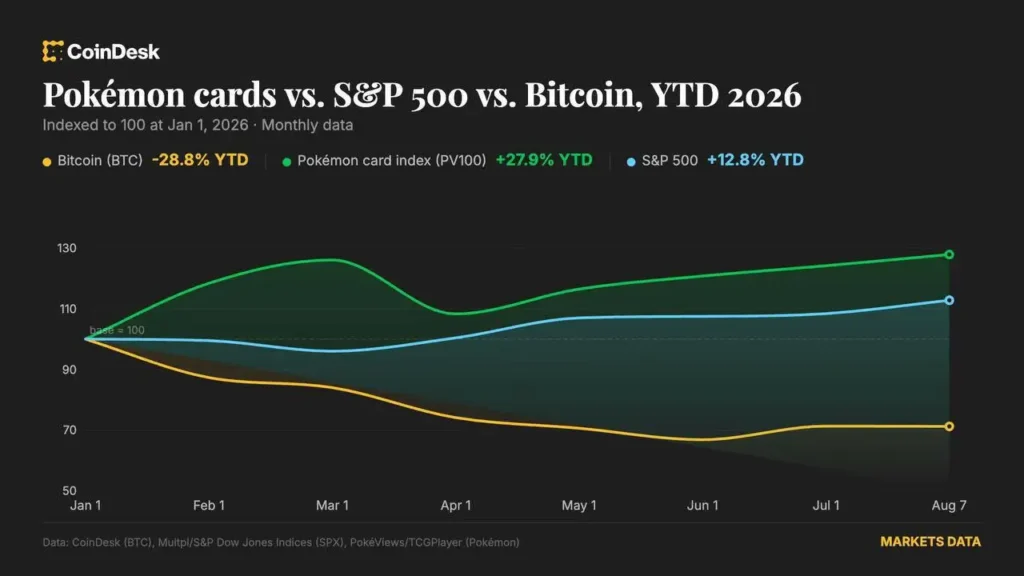
Pokémon cards have emerged as an unexpected performer in the collectibles market in 2026. A comparison published in August showed a Pokémon-card index gaining nearly 28% year to date, while the S&P 500 rose by approximately 13% and Bitcoin fell by nearly 29% over the same period.
The results attracted attention from collectors and alternative-asset enthusiasts. However, the performance of a selected group of collectible cards is not the same as the return an average collector would earn. Index composition, valuation methods, transaction costs, and the period being measured all matter.
This article examines the reported 2026 performance, more recent Pokémon-card market trends, the factors behind collectible prices, and the risks of treating trading cards as investments.
Pokémon Cards vs. Bitcoin and the S&P 500: The 2026 Numbers
An August 2026 comparison reported the following year-to-date performance through August 7:
| Asset or benchmark | Reported return | Period |
|---|---|---|
| Pokémon-card index | +27.9% | Year to date through August 7, 2026 |
| S&P 500 | +12.8% | Year to date through August 7, 2026 |
| Bitcoin | -28.8% | Year to date through August 7, 2026 |
In that historical snapshot, the Pokémon-card benchmark outperformed both comparison assets. Its reported gain was 15.1 percentage points higher than the S&P 500’s return, while Bitcoin was substantially lower.
These figures should not be presented as current returns for October 2026. They describe a specific historical period, and the result depends on the Pokémon index used in the comparison. They also do not establish that all Pokémon cards rose in value.
What has changed since the August comparison?
More recent market data shows why the measurement period matters. CardTrack’s October 2026 report, based on data as of October 1, recorded a 3.3% increase in its broader Pokémon-card index over the preceding 30 days. During the same report’s comparison period, Bitcoin rose 9.3% and the S&P 500 gained 2%.
In that shorter window, Pokémon cards outperformed the S&P 500 but did not keep pace with Bitcoin. This does not contradict the August year-to-date comparison: the figures cover different periods and use different benchmarks.
The key takeaway: Pokémon cards showed strong relative performance in the reported year-to-date comparison through August 7, but the market does not move in a straight line. Shorter-term results can differ substantially, and a fair comparison requires matching dates and transparent index methodology.
Which Pokémon Card Index Is Being Compared?
A return figure is only as useful as the index behind it. Pokémon-card indices track different groups of cards, and their results are not interchangeable.
CardTrack’s broader Pokémon index
CardTrack publishes a broader index covering thousands of cards. Its annual market report for 2025 tracked 6,615 cards and reported an 82.3% increase for that year, based on PriceCharting’s monthly price history. This is a separate measure from CardTrack’s index of the most valuable individual cards.
CardTrack’s longer historical series also reported that its 58-card, equal-weighted raw-card basket stood at 479 in July 2026, compared with a base of 100 in February 2021. That represents a 379% increase over the period. The result describes that specific basket and does not mean every card appreciated by 379%.
CardTrack 100
The CardTrack 100 is a separate index tracking the 100 most valuable raw Pokémon single cards, weighted by price and rebalanced monthly. Because the most expensive cards have the greatest influence, this index represents the top end of the market rather than the typical card in a collection.
A report published in October 2026 stated that the CardTrack 100 had returned 150.7% since September 2021. That figure covers a longer historical period and a different index from the broader 2026 year-to-date comparison above. It should not be used as evidence of a 150.7% gain during 2026.
Why different indices produce different results
- Different card selections: An index of the most valuable cards can behave differently from a broad basket of vintage and modern cards.
- Different weighting: Equal-weighted and value-weighted indices assign different levels of influence to individual cards.
- Different price sources: Some indices use completed sales, while others may rely on blended estimates or price histories.
- Different update schedules: Daily data can reflect market changes faster than monthly historical series.
- Different costs: An index return does not necessarily account for grading fees, marketplace commissions, shipping, insurance, or taxes.
For a meaningful comparison, readers should check the index methodology, the exact dates covered, and whether the figures represent raw cards, graded cards, or a combination of both.
Why Are Pokémon Cards Attracting Collectors?
Pokémon cards combine nostalgia, scarcity, character recognition, competitive play, and a global collector community. These factors can support demand for particular cards, although they do not guarantee that prices will rise.
Rarity and limited supply
Promotional cards, cards distributed through special events, and older releases may be difficult to find in desirable condition. Limited supply can support prices when demand remains strong, but rarity alone is not enough: a scarce card with little buyer interest may still be difficult to sell.
Condition and professional grading
Corners, edges, surface quality, centering, and authenticity can substantially affect a card’s value. Professional grading provides an assessment of condition and can make comparisons between cards easier. High grades may command premiums, particularly for sought-after cards.
Grading is not a guarantee of profit. Fees, shipping costs, turnaround times, and the risk of receiving a lower-than-expected grade can all reduce the potential benefit.
Nostalgia and franchise popularity
Collectors may be willing to pay more for cards associated with memorable characters, early releases, iconic artwork, or milestones in the Pokémon franchise. Demand can also change as new games, media, and card releases attract attention.
Market visibility and completed sales
Online marketplaces and auction platforms make it easier for collectors to discover cards and compare transactions. However, an asking price is not proof of market value. Recent completed sales for the same card, printing, language, and condition provide more useful evidence of what buyers have actually paid.
Record-Breaking Pokémon Card Sales in 2026
High-profile auctions have drawn attention to the value of exceptionally rare Pokémon cards. These sales illustrate the potential worth of specific collectibles, but they should be considered separately from broad market indices.
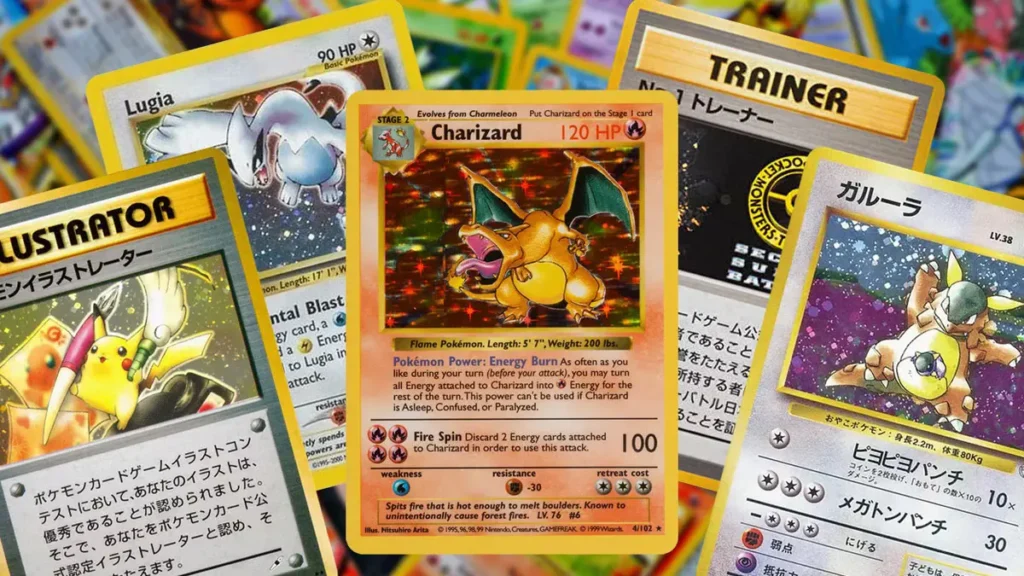
Logan Paul’s Pikachu Illustrator sells for $16.492 million
In February 2026, Logan Paul’s Pikachu Illustrator card, graded PSA Gem Mint 10, sold through Goldin for a reported total of $16,492,000. Guinness World Records recognized the transaction as the most expensive trading card sold at auction.
The reported total includes the buyer’s premium. The winning bid itself was $13.3 million, with the premium bringing the final amount to $16.492 million.
Pikachu Illustrator is an unusual promotional card associated with a 1998 illustration contest rather than an ordinary retail release. Its scarcity, history, condition, and public profile helped make it an exceptional auction item.
Why one auction does not represent the whole market
Record prices are influenced by rarity, condition, provenance, buyer competition, and the circumstances of a particular auction. They do not establish the resale value of every copy of a card, nor do they show that the average Pokémon card is appreciating at a similar rate.
Collectors should compare multiple completed transactions whenever possible and distinguish a record-setting sale from a price that can routinely be achieved.
Retail Growth Is Not the Same as Pokémon Card Investment Returns
Retail data offers another view of consumer interest. In September 2025, Target reported that its broader trading-card business had grown nearly 70% year to date and was on track to exceed $1 billion in annual sales.
Those figures covered trading cards as a category, not Pokémon cards alone. They should not be presented as Pokémon-specific revenue or as a measure of the value of the secondary market.
Strong retail demand can indicate that consumers are interested in collecting, but it does not automatically translate into rising resale prices. Increased supply, new releases, reprints, and changing preferences can affect individual cards in different ways.
Are Pokémon Cards a Good Investment in 2026?
Pokémon cards may appeal to collectors who understand the hobby and are comfortable with the risks of owning physical collectibles. However, the available data does not establish that Pokémon cards are consistently profitable or low-risk investments.
Potential advantages
- Some scarce vintage and promotional cards have demonstrated strong collector demand.
- Completed auction and marketplace sales provide data that can help buyers research prices.
- Professional grading can help document condition and authenticity.
- Collecting can provide personal enjoyment independent of financial performance.
Important risks
- Price volatility: Individual cards can appreciate or decline sharply.
- Limited liquidity: A card may take time to sell, even if a price guide assigns it a high value.
- Transaction costs: Grading, shipping, insurance, marketplace fees, and taxes can reduce net proceeds.
- Authenticity and condition: Counterfeits, alterations, damage, and grading uncertainty can affect value.
- Changing supply: New releases and reprints may influence demand for particular products.
- Concentration risk: A collection focused on one character, set, or trend may be exposed to a narrow set of risks.
Anyone considering Pokémon cards as an investment should evaluate the specific card, use recent completed sales, calculate all costs, and avoid assuming that past returns will continue. This article is for informational purposes and is not financial advice.

What Could Affect Pokémon Card Prices Through the End of 2026?
The market is made up of different segments, including vintage cards, modern chase cards, promotional releases, graded collectibles, and sealed products. These segments do not necessarily move together.
Several factors may influence prices during the remainder of 2026:
- Collector demand: Popular characters, anniversary releases, and renewed interest in older sets may affect demand for particular cards.
- Available supply: Reprints, new products, and the number of cards entering the market may influence scarcity.
- Completed sales: Changes in transaction volume and realized prices can help distinguish sustained demand from temporary attention.
- Economic conditions: Household budgets and broader market sentiment can affect spending on discretionary collectibles.
- Grading and authentication: Confidence in a card’s condition and authenticity can influence what buyers are willing to pay.
These factors provide a framework for monitoring the market, not a reliable prediction of future returns. The strong year-to-date result reported in August does not guarantee that Pokémon cards will continue to outperform Bitcoin or the S&P 500 through December.
How to Evaluate a Pokémon Card Before Buying or Selling
- Identify the exact card.
Confirm the set, card number, language, printing, edition, and any special features. - Review completed sales.
Compare transactions for the same card and condition rather than relying exclusively on active listings. - Verify grading details.
For graded cards, check the grading company, assigned grade, and certification details where available. - Calculate total costs.
Include grading, shipping, insurance, marketplace commissions, and applicable taxes. - Consider liquidity.
Check how frequently comparable cards sell and how long it might take to find a buyer. - Keep documentation.
Save purchase receipts, grading records, provenance documents, and sale information.
These steps can improve the quality of a buying or selling decision, but they cannot eliminate market risk or guarantee a future selling price.
Final Takeaway
Pokémon cards delivered a striking result in one widely reported 2026 year-to-date comparison: through August 7, the benchmark gained 27.9%, compared with 12.8% for the S&P 500 and a 28.8% decline for Bitcoin. That result helps explain why collectible cards have attracted attention beyond the traditional collecting community.
More recent data, however, shows that performance varies by period. CardTrack’s October report recorded a 3.3% increase in its broader Pokémon index over the preceding 30 days, while Bitcoin and the S&P 500 gained 9.3% and 2%, respectively, over the report’s comparison period.
The evidence supports a measured conclusion: some Pokémon-card benchmarks have outperformed major financial assets over selected periods, but the result is not universal. Index composition, price methodology, transaction costs, and the specific cards being evaluated all matter.
For collectors, the most useful approach is to research the exact card, compare completed sales, understand the costs, and treat past performance as context rather than a promise of future returns.
This article is for informational purposes only. It is not financial or investment advice, does not constitute a recommendation, and should not be interpreted as a call to buy, sell, or invest in Pokémon cards, Bitcoin, or any other asset.
Frequently Asked Questions
Did Pokémon cards outperform Bitcoin and the S&P 500 in 2026?
In a comparison published in August 2026, a Pokémon-card index gained 27.9% year to date through August 7, compared with 12.8% for the S&P 500 and a 28.8% decline for Bitcoin. That historical comparison showed outperformance over the specified period, but it does not establish current returns for October or the performance of every Pokémon card.
Are Pokémon cards still outperforming stocks and Bitcoin?
Performance depends on the period and index. CardTrack’s October 2026 report showed its broader Pokémon index up 3.3% over the preceding 30 days, while Bitcoin rose 9.3% and the S&P 500 gained 2% during the comparison period. Pokémon cards outperformed stocks but lagged Bitcoin over that shorter window.
What is the difference between the CardTrack Pokémon index and the CardTrack 100?
CardTrack publishes multiple measures. Its broader Pokémon index tracks a much larger group of cards, while the CardTrack 100 focuses on the 100 most valuable raw Pokémon singles and weights them by price. Because their compositions and methodologies differ, their returns should not be treated as interchangeable.
What was the most expensive Pokémon card sold at auction?
In February 2026, Logan Paul’s Pikachu Illustrator card graded PSA Gem Mint 10 sold through Goldin for a reported $16,492,000, including the buyer’s premium. Guinness World Records recognized the transaction as the most expensive trading card sold at auction at the time.
Does a rising Pokémon card index mean my cards are worth more?
Not necessarily. An index may track a selected group of cards, such as the most valuable examples. The value of an individual card depends on its identity, condition, supply, demand, and recent completed sales.
Are rare Pokémon cards guaranteed to increase in value?
No. Rarity can support demand, but it does not guarantee appreciation or easy resale. Prices may decline, and selling costs can reduce or eliminate any profit.
Should I use asking prices to value a Pokémon card?
Asking prices show what sellers hope to receive, not necessarily what buyers will pay. Recent completed sales for the same card and condition are generally more useful, although a single transaction may still be unrepresentative.