
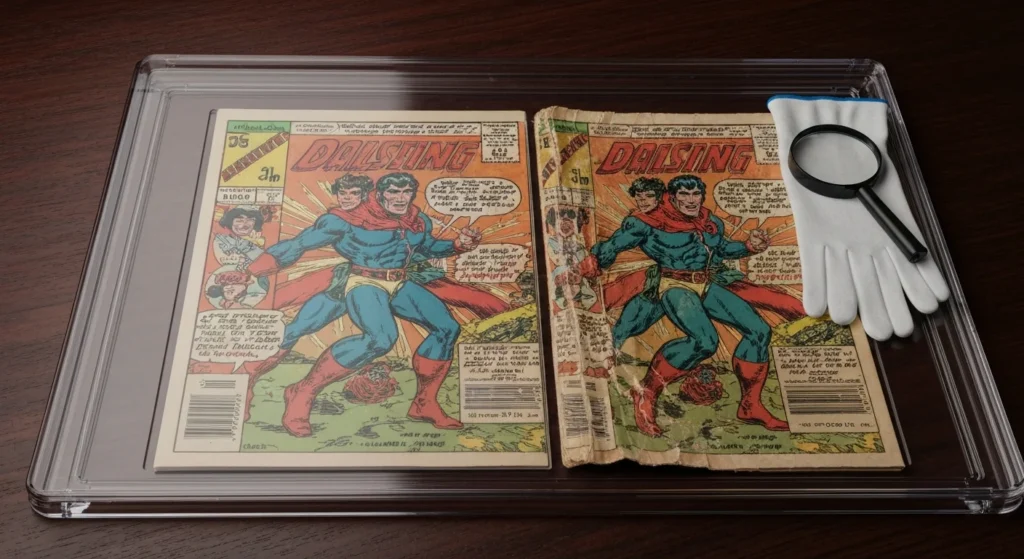
For anyone assessing a collection in 2026, the bottom line is clear: a comic book’s condition is the primary driver of its ultimate market value, frequently causing the price of the exact same issue to swing by thousands of percent. For high-demand key issues, a microscopic spine split or a single speck of foxing can reduce a book’s valuation by tens of thousands of dollars. To maximize your financial return, choose professional third-party grading for any high-value vintage key issue, while keeping lower-tier modern books raw to avoid eating your profit margins in grading fees. For raw collections, utilizing a structured, conservative grading approach ensures you set realistic expectations before selling. Comic book pricing operates on an exponential curve rather than a linear one; a book in near-flawless condition commands vast premiums because of its extreme rarity, whereas the same comic in heavily creased condition may only fetch a tiny fraction of that price. Understanding these nuances protects you from leaving money on the table or overpaying for overgraded material.
Key Takeaways
- The condition-to-value curve is exponential: Small improvements in physical grade at the top end of the scale yield massive financial leaps.
- Professional certification standardizes pricing: Third-party grading services like CGC and CBCS eliminate subjective disagreements between buyers and sellers.
- Specific structural defects are critical: Hidden issues like spine splits, color-breaking creases, staple rust, and restoration slash a comic’s value instantly.
- Era dictates condition tolerance: Golden and Silver Age keys remain highly valuable even in poor condition, whereas modern books require near-perfection to hold value.
- Proper archival preservation is non-negotiable: Using mylar bags, acid-free backing boards, and controlled environments protects your long-term investment.
Why Comic Book Condition Determines Price
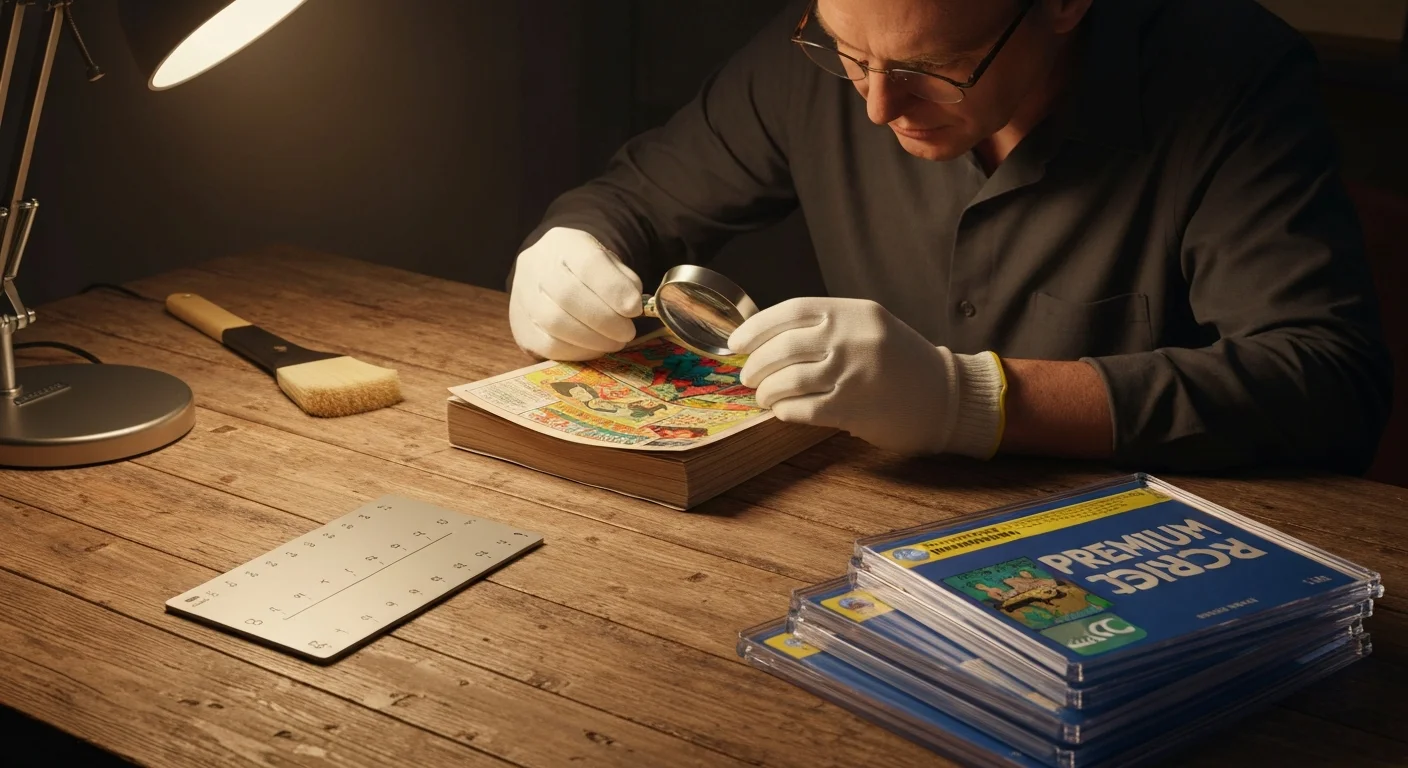
Condition is the ultimate proxy for historical preservation and rarity in the collectibles market. When a comic book is printed, it is an inherently fragile object made of cheap, acidic pulp paper designed for temporary entertainment rather than archival preservation. Over decades, environmental factors, handling, and improper storage decay these fragile materials, making pristine vintage copies exceptionally rare.
The modern comic book marketplace values this rarity above almost all else. According to historical transaction tracking by GPAnalysis, high-grade specimens routinely outperform lower-grade counterparts of the exact same issue by thousands of percentage points. This phenomenon reflects the concept of grade scarcity. While thousands of copies of a specific vintage comic may exist globally, only a handful might survive in Near Mint condition.
This market reality creates a sharp price curve. For example, a mid-grade comic book might have a physical population of hundreds of copies, satisfying the demand of casual collectors. However, the elite tier of investors and high-end collectors compete fiercely for the single-digit population of top-tier copies. This intense competition drives auction prices into six- and seven-figure territories for top-grade historical keys, while lower-grade copies of the same issue remain accessible for modest sums.
The Overstreet Grading Scale Explained
The standard baseline for assessing comic book condition is the Overstreet Grading Scale, a highly structured system that translates physical state into numerical values. This scale ranges from 10.0 down to 0.1, establishing a universal language for collectors. To get a sense of how these physical tiers translate to real-world value, consulting a dedicated comic book price guide is an essential first step for any collector looking to assess their inventory.
The high-grade tier begins with Mint conditions. A Gem Mint 10.0 or Mint 9.9 is virtually non-existent for vintage books, representing a comic with no visible flaws even under magnification. Near Mint/Mint 9.8 is the practical pinnacle for most collectors, denoting a book that looks fresh off the printing press with only tiny, nearly imperceptible manufacturing or handling marks. As you slide down to Near Mint 9.4 or 9.2, minor defects like tiny spine stresses or slight corner blunting begin to appear.
The mid-grade tier encompasses Very Fine (VF) and Fine (FN) conditions, running from 8.0 down to 6.0. A Very Fine 8.0 comic remains highly attractive but may exhibit several minor spine stresses, slight cover wear, or small accumulation of defects. A Fine 6.0 book shows clear signs of having been read, displaying moderate creasing, a slight spine roll, or minor surface scuffing, though it still retains overall clean structural integrity and visual appeal.
The lower-grade tier covers Very Good (VG), Good (GD), Fair (FR), and Poor (PR), spanning from 4.0 down to 0.5. A Very Good 4.0 copy shows significant wear, including larger creases, potential staple tears, and cover soil, though the cover remains attached. Good 2.0 comics are heavily worn, often featuring minor chunks missing, cover detachment, or heavy staining. Poor 0.5 books represent heavily damaged items, possessing major spine splits, severe water damage, missing pages, or heavy defacement, making them readable but structurally compromised.
How Professional Grading Impacts Comic Value
Professional third-party grading services have revolutionized the comic book market by replacing subjective seller assessments with certified, objective evaluations. Organizations like the Certified Guaranty Company (CGC) use a team of professional graders to inspect, grade, and permanently seal comics in tamper-evident, protective plastic capsules known as slabs. This process completely alters the pricing dynamic of a transaction.
The premium paid for certified books is substantial. A raw, ungraded comic book carries an inherent risk for the buyer, who must trust the seller’s description or rely on low-resolution digital photographs. Professional grading eliminates this risk by verifying authenticity, identifying hidden restoration, and guaranteeing the numerical grade. Consequently, a certified comic book often commands a pricing premium of 30% to over 300% compared to an identical copy sold in a raw state.
Below is a comparison table illustrating how condition grades affect the relative market value multiplier across a standardized vintage key issue, assuming a baseline value of 1.0 for a standard Fine (6.0) copy:
| Overstreet Grade | Physical Condition Description | Typical Market Value Multiplier |
|---|---|---|
| 9.8 (Near Mint/Mint) | Nearly flawless; outstanding eye appeal; tiny bindery defects only. | 8.0x to 15.0x+ |
| 9.0 (Very Fine/Near Mint) | Excellent preservation; very minor spine stress; sharp corners. | 3.5x to 5.0x |
| 8.0 (Very Fine) | Highly attractive; small accumulation of minor cover and spine defects. | 2.0x to 2.5x |
| 6.0 (Fine) | Read and enjoyed; moderate creasing; baseline collectible quality. | 1.0x (Baseline) |
| 4.0 (Very Good) | Significant wear; accumulation of creases; possible minor staple tears. | 0.4x to 0.6x |
| 2.0 (Good) | Heavily worn; cover may be partially loose; minor spine split present. | 0.15x to 0.25x |
Common Condition Defects That Slash Value
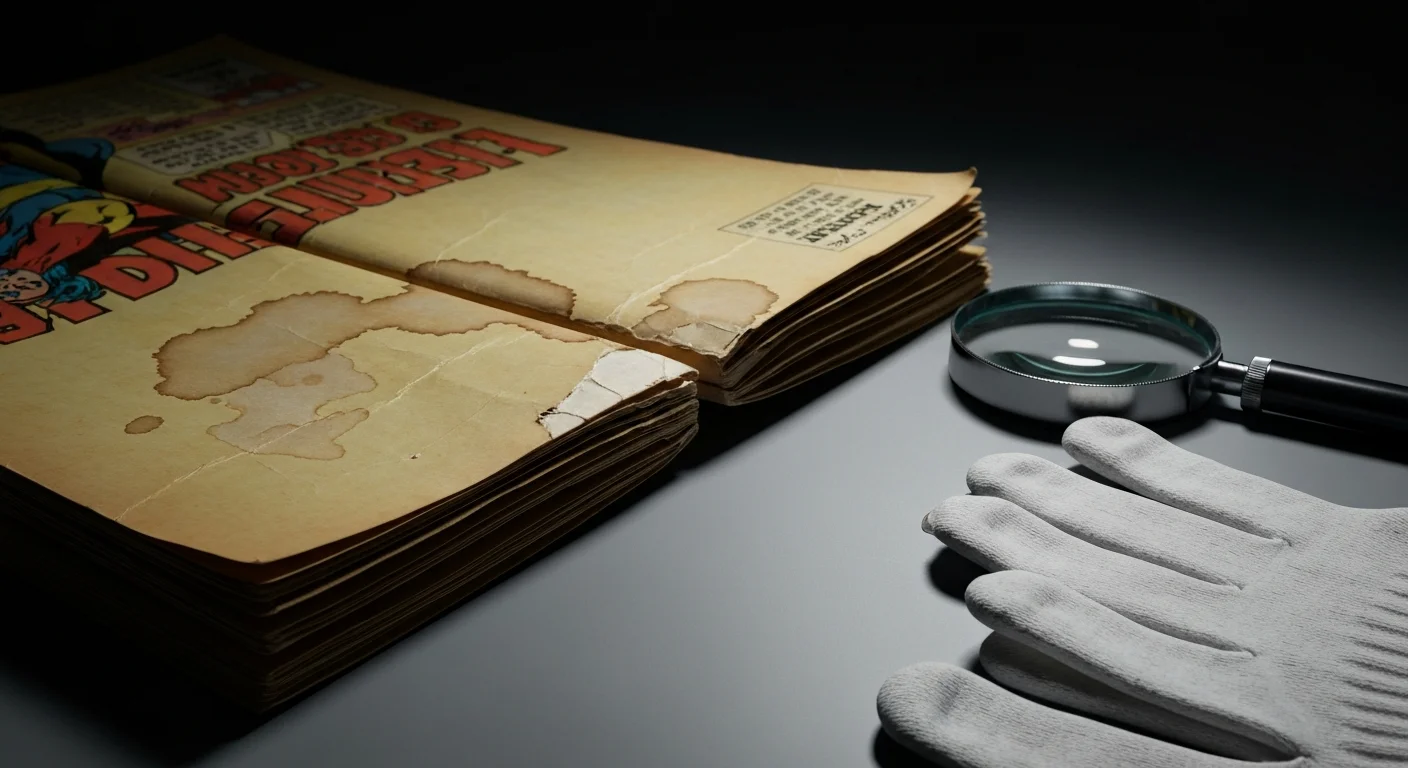
Understanding the specific structural and cosmetic issues that graders look for is critical to identifying hidden value drops. Professional comic book appraisers examine every millimeter of a book under dedicated lighting. Certain defects are particularly devastating to a book’s final grade and financial worth.
- Color-Breaking Creases: Unlike minor bends that can sometimes be pressed out, a crease that breaks the printed ink cannot be repaired. These marks reveal the white paper underneath and immediately cap the book’s potential grade, typically preventing it from scoring above a mid-grade tier.
- Spine Splits and Stress Marks: The spine is the structural backbone of the comic. Stress marks caused by opening the book too wide can accumulate and break color. Worse, actual spine splits along the fold can cause the cover or internal pages to detach entirely, which severely penalizes the final grade.
- Rusty Staples and Rust Migration: Exposure to humidity causes original metal staples to rust. This rust can migrate onto the surrounding paper, creating unsightly orange-brown stains and weakening the paper fibers, which frequently leads to loose or detached covers.
- Restoration (The Purple Label): Any attempt to amateurishly repair or improve a comic, such as using glue, color touch-ups, or trimming the edges, is detected by professional grading houses. Certified books found to have restoration are given a distinct purple label, which can instantly slash the book’s value by 50% or more compared to an unrestored blue-label equivalent.
- Acidic Page Degradation: Over time, acid in pulp paper causes pages to yellow and become brittle. Graders assign a page quality rating, such as White, Off-White, Cream, or Tan. Brittle, tan pages are prone to flaking and tearing, dramatically reducing the book’s value.
Modern Comics vs. Vintage Books: The Condition Sensitivity Gap
The market treats condition with vastly different levels of tolerance depending on the era of the comic book. This discrepancy is driven by historical printing volumes, collector habits, and survival rates over time. Modern books and vintage books operate under completely different market dynamics.
For modern comic books, which include issues from the mid-1980s to the present day, the margin for error is razor-thin. Modern issues were printed in large quantities, and collectors immediately placed them into protective bags and boards. Consequently, high-grade copies are incredibly common. A modern key issue in a CGC 9.6 grade might struggle to command a premium, while a CGC 9.8 or 9.9 is required to capture serious financial value. If a modern book drops below a 9.4, its market value often plummets to near-zero because the supply of pristine copies is so abundant.
Vintage books from the Golden Age (1930s to 1950s) and Silver Age (1956 to 1970) operate under different rules. These books survived eras when comics were viewed as disposable children’s entertainment, with many destroyed in paper drives or discarded over time. As a result, even heavily damaged copies are highly prized. According to historical transaction records from Heritage Auctions, a highly coveted Silver Age classic in low grade (such as a 1.8 Good) can still command $10,000 to $15,000, while a flawless 9.8 specimen can rocket past $400,000. This preservation disparity is similar to other collectible markets, such as the trading card industry where card condition dictates values similarly; for context on how other markets handle these standards, see our guide on CGC card grading.
Best Practices for Preserving Your Comic Book’s Condition
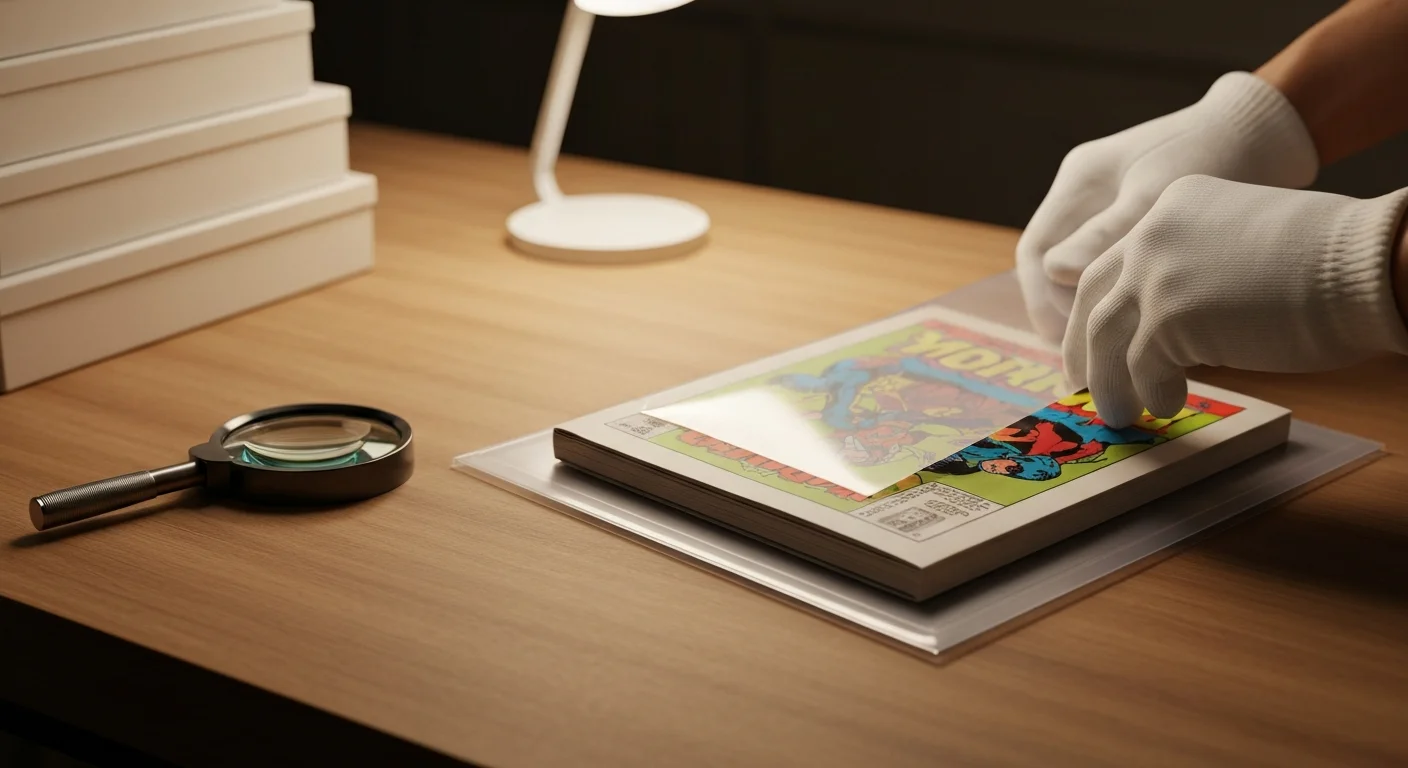
Protecting your comic books from environmental degradation is the easiest way to preserve their long-term equity. Passive neglect in an attic or basement can ruin a collection within a few years, as heat, humidity, and atmospheric acids take their toll. Implementing a professional-grade archival system is essential for any serious collector.
First, upgrade your storage materials. Standard polyethylene or polypropylene bags break down over time, releasing chemicals that can yellow cover paper. Replace these with archival-grade Mylar bags (such as Mylites), which are chemically inert and offer superior clarity and UV protection. Always pair them with acid-free backing boards. Standard cardboard backing boards contain harmful acids that will bleed into your comic books; utilizing genuine acid-free boards prevents this yellowing process.
Second, control the storage climate. Keep your comic boxes in a temperature-controlled area of your home, avoiding uninsulated attics, damp basements, or rooms with significant sunlight exposure. The ideal storage environment is a cool, dry room kept at roughly 55 to 65 degrees Fahrenheit with a stable relative humidity of 35% to 45%. High humidity promotes mold growth and staple rust, while extreme heat accelerates the chemical breakdown of the paper fibers.
Finally, practice proper handling protocols. Always wash and dry your hands thoroughly before touching raw comic books to remove natural skin oils, or wear clean, lint-free cotton gloves. Never bend the spine backwards when reading, and store books upright in dedicated heavy-duty comic storage boxes. Avoid packing boxes too tightly, as this causes corner bending and spine warping over time. Taking these simple steps ensures your collection retains its visual appeal and maximum market value for decades to come.
FAQ
What is the most important factor in determining a comic book’s grade?
Overall structural and cosmetic preservation is key, with the spine and cover being the most critical areas. Graders look closely for color-breaking creases, spine splits, corner wear, and staple integrity. Even a book with pristine interior pages will receive a low grade if the cover displays heavy wear or tearing.
Can a restored comic book still hold significant value?
Yes, restored comic books can hold value, especially if they are extremely rare Golden Age or early Silver Age key issues. However, they sell at a steep discount, often commanding only 30% to 50% of the price of an unrestored copy in the equivalent grade. For modern books, restoration typically destroys almost all collectible market premium.
How do I know if my vintage comic has been restored?
Look for subtle signs of tampering, such as off-color paint touch-ups on the cover, glue along the spine, pages that have been trimmed to look sharper, or staples that have been replaced. Professional grading services use specialized ultraviolet lighting and magnification to spot these alterations, which is why third-party grading is highly recommended for expensive keys.
Is a comic book with a name written on the cover worth less?
In most cases, a name written on the cover does lower the grade and value, though the impact is far less severe for vintage books. During the Golden and Silver Ages, newsstand owners or original owners frequently wrote names or dates on covers, which graders treat as minor handling wear. For modern books, however, writing on the cover is a major defect that severely hurts the grade.
Can pressing and cleaning a comic book improve its value?
Yes, professional pressing and dry cleaning can safely remove non-color-breaking wrinkles, dirt, and minor roll defects without altering the book’s structure. This process is fully accepted by grading companies like CGC and can successfully bump a book’s grade up several points, unlocking substantial financial premiums when done by an experienced professional.
When should I pay to have a comic book professionally graded?
You should consider professional grading when the estimated market value of the comic book in its current condition significantly exceeds the cost of the grading fees and shipping. Grading is highly recommended for high-value vintage key issues, major character debuts, or modern key issues that appear to be in flawless, high-grade condition.