
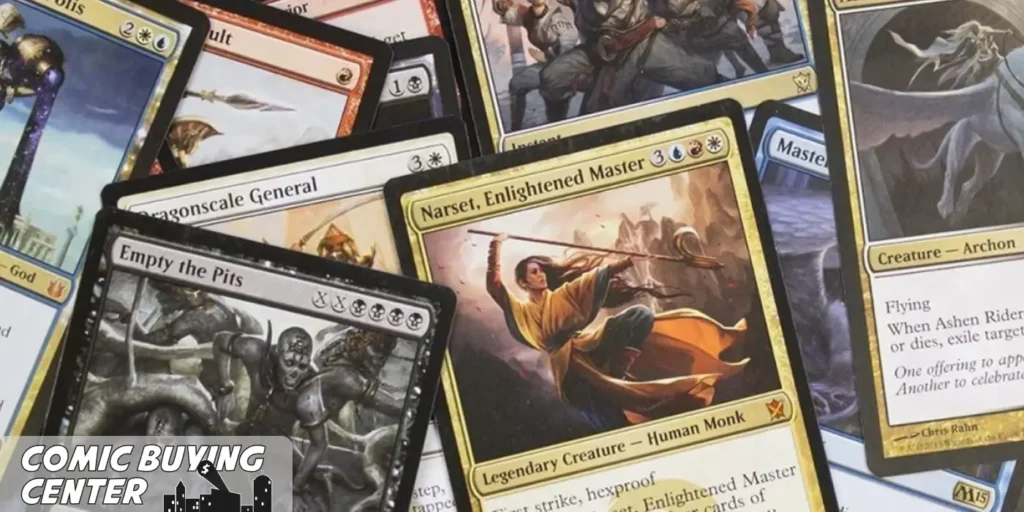
Card rarity in Magic: The Gathering describes how often a card appears in booster packs. There are four levels: common, uncommon, rare, and mythic rare.
Commons show up the most, and you’ll see several in every pack. Uncommons appear less frequently. Rares appear roughly once per pack, and mythic rares about once every eight packs.
Rarity affects both how hard a card is to find and, generally, how powerful it is. Mythic rares usually have the most impactful abilities, which is why they’re so popular in competitive play and cost the most on the secondary market.
But rarity alone doesn’t determine value; any MTG rarity guide would agree on that. A common card with the right ability can be worth more than some rares. The market cares about usefulness and demand, not just how hard something is to pull. But that is a factor too, of course.
MTG Rarity Symbols: How to Read Them
Every Magic card has a small symbol in the middle-right of the card, just below the artwork. It’s one of the fastest ways to guess a card’s value at a first glance.
The Expansion Symbol (Set Symbol Color)
The expansion symbol appears on every Magic card and serves two purposes: it identifies which set the card came from, and its color indicates rarity.
MTG rarity colors are black (common), silver (uncommon), gold (rare), and orange-red (mythic rare).
Older cards, which are anything printed before 1999, don’t follow this system. They predate rarity symbols, which is part of why identifying early cards can be tricky without some background knowledge.
Foil cards add another layer. A foil common still shows a black symbol, but the card’s finish often pushes the price above a standard uncommon or even rare.
The Collector Number and Letter Code
Every Magic card has a collector number printed at the bottom, formatted as a fraction, for example, 214/280. The first number is the card’s position within the set, and the second is the total number of cards in that set.
Some cards also carry a letter suffix after the number. A “⭐” or letter like “a” or “b” indicates a variant – alternate art, a different frame treatment, or a special version of the same card.
For collectors, these numbers matter. Serialized cards display their individual number (like 077/250), which directly shows rarity and is a major driver of value in modern premium sets.
How to Find Rarity on Old MTG Cards (Pre-1998)
Cards from Alpha, Beta, Unlimited, Arabian Nights, Antiquities, and most sets through early 1998 were printed before Wizards of the Coast introduced the rarity symbol system, so that a standard MTG rarity guide won’t help. There’s no colored icon to check.
For these cards, rarity comes down to research on the print sheet. Each set was printed on large sheets, and cards appeared on those sheets in different numbers. A card printed once on the sheet was rare. Printed more often – uncommon or common.
The most reliable approach is to look up the card in a dedicated database like Scryfall or MTG Wiki, which documents rarity for every card in every set.
The Four Main MTG Rarities Explained
- Common. The majority of every set. You’ll get multiple commons in each pack, which means they’re printed in the largest quantities. Most commons are simple, straightforward cards, but don’t write them off entirely. A handful of commons are worth real money, simply because players need four copies for their decks.
- Uncommon. Each pack contains a few uncommons, making them less abundant than commons but still widely available. Some of the most beloved utility cards in Magic’s history – removal spells, card draw, and mana fixing are uncommon.
- Rare. One per pack. Rares usually carry the most impactful abilities and make up the bulk of high-value singles on the secondary market. Building a competitive deck usually means tracking down specific rares, which is why demand is more or less consistent.
- Mythic Rare. Introduced in 2008, mythic rares appear roughly once every eight packs. They’re designed to be the most powerful and visually striking cards in a set – planeswalkers, game-ending creatures, strategy-defining spells. Needless to say, they’re usually the most expensive cards.
Special and Premium MTG Card Types
Magic: The Gathering card rarity symbols and collector numbers are the most obvious signs, but not the only ones. Understanding special treatments is what separates a casual collector from someone who knows what they’re actually holding.
Foil Cards
Foil cards have a shiny, reflective finish that standard cards don’t. They’ve been part of Magic since 1999 and appear at every rarity level – a foil common is still a common, but it’s worth more than a non-foil version of the same card.
Value varies widely. A foil copy of a heavily played competitive card can be worth several times the standard version. A foil common nobody plays is worth almost nothing.
Condition matters more with foils, too, because they scratch and curl much more easily than regular cards.
Promo Cards
The same card in promo form is almost always worth more than its regular printing. How much more depends on how the promo was distributed. Cards handed out at large public events are common. Cards given only to tournament winners or regional champions can be super rare.
Condition matters more than usual because a damaged promo loses most of its premium.
A few examples worth knowing: the Judge Foil Wasteland, given exclusively to certified tournament judges, regularly sells for $300-$500. The Tifa Lockhart promo from the Final Fantasy Secret Lair, distributed in extremely limited quantities, costs $4,500 or more for foil copies. The 1996 World Champion card, awarded to that year’s MTG champion, is one of only a tiny handful of copies ever made and has never had a publicly confirmed sale price.
Serialized Cards
Serialized cards carry an individual number stamped directly on the card (for example, 047/500) telling you exactly how many copies exist. Wizards of the Coast introduced them with the Lord of the Rings set in 2023, and they’ve appeared in nearly every major release since.
The lower the total print run, the more valuable the card. The One Ring at 001/001 is the end – just one copy in the world. But even larger runs can be costly. The Golden Traveling Chocobo from the Final Fantasy set was limited to 77 copies and sells for $55,000+. Serialized Sol Rings from the Lord of the Rings set, with 900 copies printed, still trade for $300-$500 each.
Masterpiece Series and Special Treatments
Masterpiece Series cards are ultra-premium reprints included as extremely rare bonus cards in certain sets, usually one in every 144 packs or rarer. They feature completely new artwork, a distinct frame, and production quality above anything in the main set. They’re legal to play but exist purely as collector trophies.
Wizards has expanded the concept to include broader “special treatments” like alternate art, textured foils, borderless frames, anime-style illustrations, and etched finishes. The same card can exist in six or more versions with wildly different price tags.
A Masterpiece Mana Crypt from Kaladesh Inventions sells for $300-$500. The Stained Glass planeswalker series from War of the Spark cost about the same. Surge Foil and Neon Ink treatments from recent sets have pushed certain copies past $1,000.
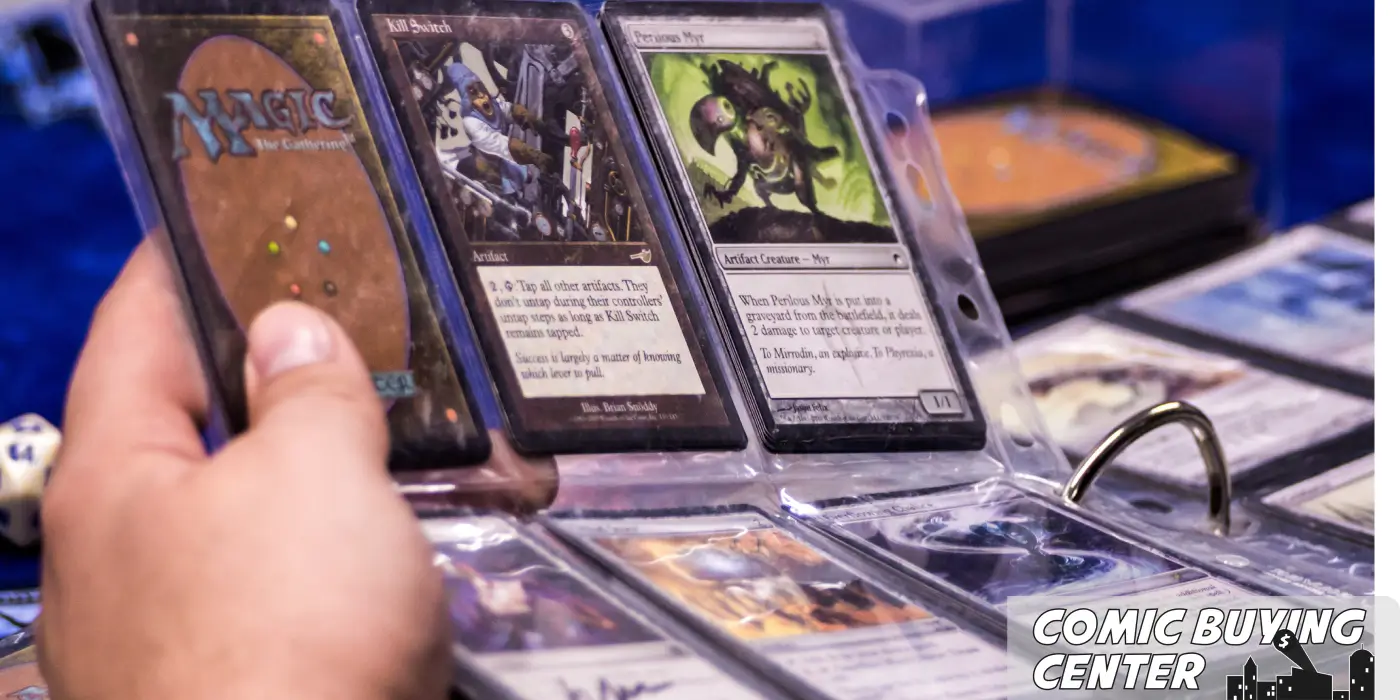
Does Rarity Equal Value?
Not always. MTG card rarity equals availability, but value comes from demand. A mythic rare nobody plays is worth a few cents. A common that every competitive deck runs four copies of can be worth $5-$10 purely because players actually need it.
The most expensive cards in Magic’s history are rare, but they’re expensive because they’re powerful, historically significant, or both. Rarity alone just means fewer copies exist.
How to Tell if a Magic: The Gathering Card is Fake
- Check the Card Weight. Genuine Magic cards weigh approximately 1.77 grams. Fakes are often slightly lighter or heavier. A simple kitchen scale can quickly show a suspicious card. Especially useful when evaluating a bulk collection.
- The Light Test (Translucency Test). Hold the card up to a light source. Authentic Magic cards have a dark inner layer sandwiched between the front and back, which blocks most light. Counterfeits often lack this layer and appear more translucent than they should.
- Examine the Print Quality (Magnifier Test). Under a loupe or magnifier, genuine cards show a consistent rosette dot pattern in the artwork. Fakes show blurry dots, smearing, or an inconsistent pattern.
Check the Feel and Card Stock. Real Magic cards have a specific texture. They are slightly rough, with a firm snap when bent. Counterfeits often feel smoother, flimsier, or just a bit weird. The edges may also look or feel different up close. - Compare to a Known Authentic Card. Lay the suspect card next to a verified real copy of the same card or any authentic Magic card. Look at font size, card borders, color saturation, and the back design. Fakes show subtle differences in the blue tone of the card back or inconsistent text spacing.
- UV Light Test. Under ultraviolet light, authentic Magic cards show a specific fluorescence pattern. The card back usually glows a consistent blue-white. Many counterfeits either don’t fluoresce at all or show a different color.
How to Check If Your Old Magic Cards Are Valuable
You’ve got a few options, and they’re all straightforward.
Start with what you’ve learned in our Magic The Gathering rarity guide. Check the set, the rarity symbol, and the collector number. If it’s pre-1998 with no symbol, look it up on Scryfall. TCGPlayer and MTGGoldfish are good for current pricing. If something does not look right about the card itself, run through the authentication checks above.
Or just bring it in. At Comic Buying Center, we do much more than sell comic books and tales of suspense comics – we buy Magic collections and know the market well. Our team offers free appraisals, just as we approach comic book grading and collection evaluation. We’ll tell you what you have and what it’s worth, and then you decide what to do next. Simple as that.
The worst outcome is finding out your cards aren’t worth much. The best outcome is finding out they are.