

When Did Pokemon Cards First Come Out?
So, when did Pokemon cards come out? Pokemon cards first came out in Japan on October 20, 1996. They were published in Japan by Media Factory and developed by Creatures Inc., working alongside the core Pokemon companies tied to the franchise (Nintendo, Game Freak, and Creatures).
It wasn’t random. Earlier that same year, the original Pokemon Red and Green Game Boy games launched in Japan (February 27, 1996) and quickly spread through trading and word of mouth.
A card game was a logical next step: the kids could collect Pokemon in real life, trade with friends, and battle without needing a Game Boy. It also gave the brand something that could live in backpacks, school desks, and hobby shops.
It was a huge success. By June 1997, Pokemon was already hosting early official card tournaments in Japan.
The First Official Pokemon Cards: The Base Set
The very first main Pokemon card set is the Base Set, released in Japan in October 1996. It was published by Media Factory and built with help from Creatures. This set established the TCG’s “rules language” and card layout, so almost every later set is based on what the Base Set introduced.
In Japan, the set introduced the core mix of Pokemon, Trainer cards, and Energy, which is the basic structure the game still uses.
Collectors also care about early print differences. The famous one is shadowless vs. shadowed cards. Shadowless cards don’t have the darker shadow next to the art frame, which makes them much harder to find and usually more desirable.
When Did Pokemon Cards Come Out in the US?
And when were Pokemon cards made in the USA? Pokemon cards first launched in the US in late 1998, when Wizards of the Coast (the company behind Magic: The Gathering) began rolling out an English-language demo product to teach people how the game works. This release was more like a “hey, here’s a new thing, try it out” intro pack used for demos and early promotion.
The first full retail release came right after that. The Base Set officially launched in the United States on January 9, 1999, published in English by Wizards of the Coast.
Why did it happen then? Pokemon was exploding in the US, so bringing the card game over was a logical next step. Wizards also helped the game spread fast by using the same kind of hobby-shop pipeline they already had for their card games, then building up organized play and first tournaments over time.
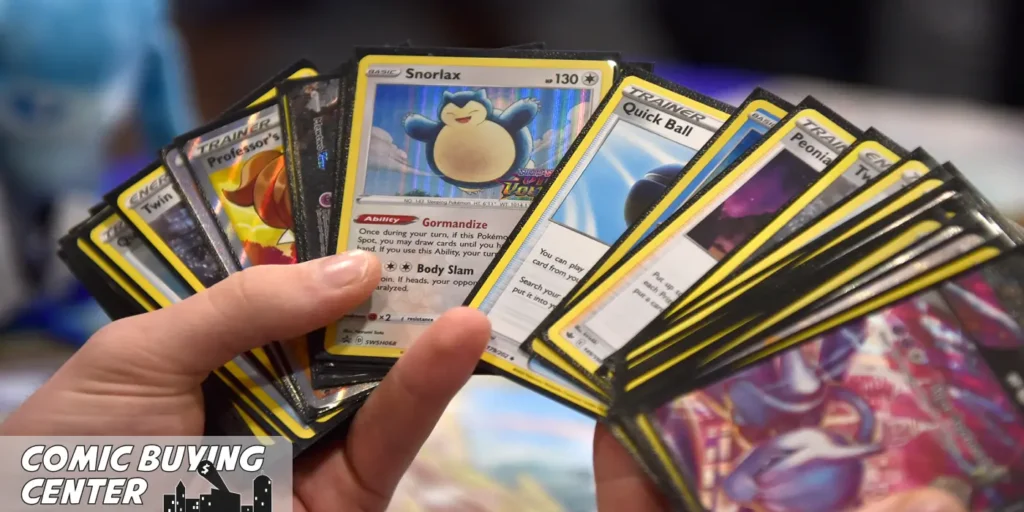
Key Events in Pokemon Card History
- Feb 27, 1996 – Pokemon Red/Green launched in Japan.
- Oct 20, 1996 – The Pokemon Trading Card Game launches in Japan (Pokemon cards’ first release).
- 1997–1998 – The famous Pikachu Illustrator trophy card is awarded through CoroCoro illustration contests (one of the rarest Pokemon cards ever).
- Late 1998 – When did Pokémon cards come out in the US? The earliest US introduction occurred in 1998, via demo products, before the main retail launch.
- Jan 9, 1999 – Pokemon TCG debuts in North America (and expands fast alongside the franchise boom).
- Oct 2000 – The Pokemon Company is established (brand management expands globally, including the TCG).
- 2001 – Pokemon USA is established in New York.
- Oct 1, 2003 – Publishing rights transition away from Wizards of the Coast to The Pokemon Company International.
- Aug 20–22, 2004 – The first Pokemon TCG World Championships is held (Orlando, Florida).
- May 23, 2007 – The Diamond & Pearl launches (English), introducing major gameplay changes like Pokemon LV.X.
- Feb 10, 2010 – HeartGold & SoulSilver launches (English).
- Mar 24, 2011 – Pokemon TCG Online launches as a browser-based game, making it much easier to learn and play digitally.
- Apr 25, 2011 – The Black & White set releases (English), a new beginning for the TCG.
- Feb 5, 2014 – XY launches (English), bringing in Mega Evolution cards and a lot of hype.
- Feb 3, 2017 – Sun & Moon launches (English), introducing Pokémon-GX and another major collecting cycle.
- Feb 7, 2020 – Sword & Shield launches (English), starting the modern era of V / VMAX-style play.
- Sep 20, 2021 – Pokemon announces Pokemon TCG Live, a big change in the digital TCG, which will replace TCG Online.
- Jul 2021 – One of the most expensive Pokemon cards, a Pikachu Illustrator card, sold for $5.275 million, becoming a huge moment for the hobby’s high-end market.
- Jun 8, 2023 – Pokemon TCG Live officially launches worldwide (the modern official digital client).
- Feb 27, 2024 – Pokemon TCG Pocket is revealed (mobile-first collecting and battling).
- Oct 30, 2024 – Pokemon TCG Pocket releases worldwide on iOS and Android.
- Dec 2024 – Pokemon TCG Pocket begins adding expansions (the “monthly drop” era starts).
- Dec 16, 2025 – Pokemon TCG Pocket’s Crimson Blaze expansion releases.
Why Early Pokemon Cards Are So Valuable Today
Early Pokémon cards are so expensive today because Pokemon is still massively popular, and collectors love owning a piece of where it all began. The first waves of cards came out when most people were just trading and playing with them, not protecting them. That means many old cards are scratched, bent, faded, or even lost, and copies in good condition are hard to find.
The supply is also very limited. No matter how many new sets get printed today, the early cards are finite, and the best-condition ones are even rarer. When something is both iconic and hard to find, prices usually stay high and often increase over time.
If you’re wondering if they are a good investment, it really depends on what you buy, the condition, and how long you’re willing to hold them (this is not financial advice; we are not financial advisors). If you want to sell Pokemon cards or even sell comic books to fuel your new TCG hobby, working with a trusted local buyer can make the process safer and easier.